
Annenberg Learner Celebrates Opening of South LA Teen Tech Center
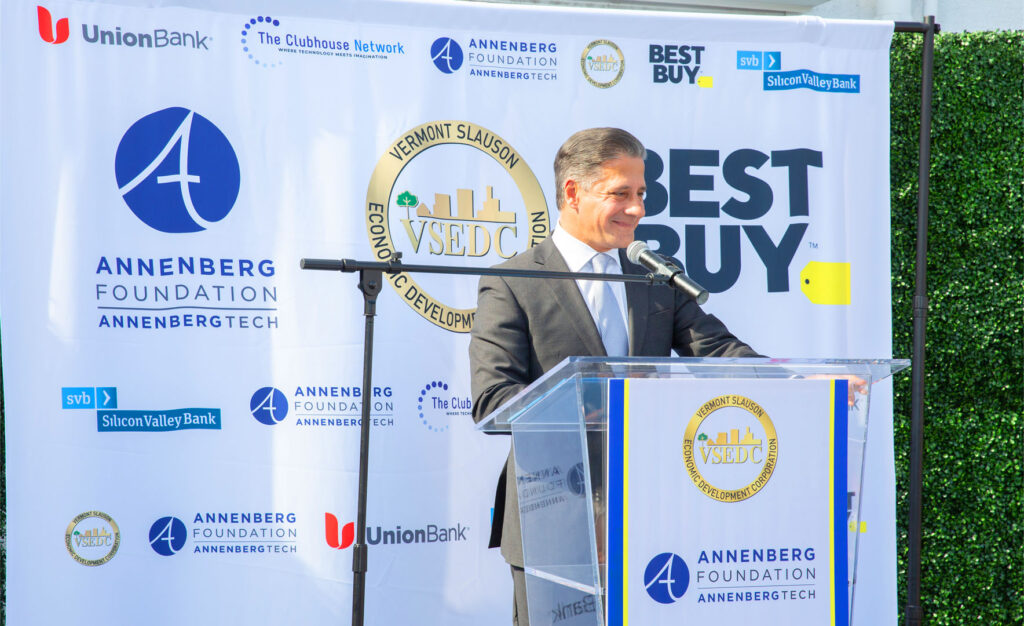
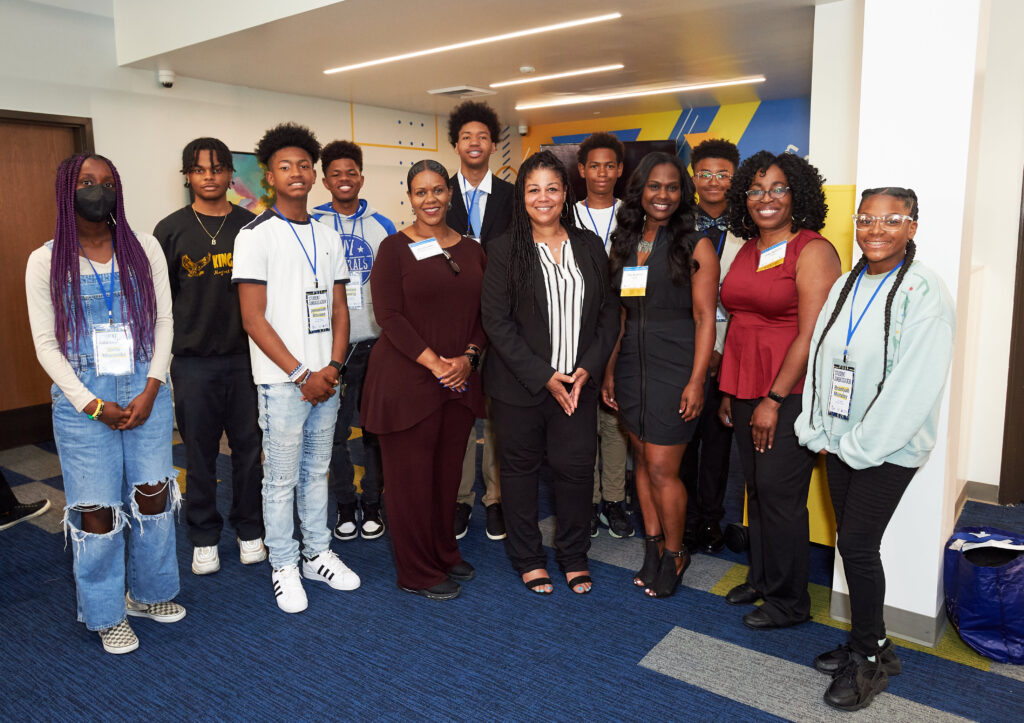
Annenberg Learner joined the AnnenbergTech team to celebrate the grand opening of the Best Buy Teen Center in South LA
This episode is part of a Teacher of the Year series where we interview innovative teachers in the field. The…
The post Episode 18: 2022 Teacher of the Year with Michelle Stradford appeared first on Annenberg Learner.
]]>The post Episode 18: 2022 Teacher of the Year with Michelle Stradford appeared first on Annenberg Learner.
]]>This episode is part of a Teacher of the Year series where we interview innovative teachers in the field. The…
The post Episode 17: 2022 Teacher of the Year with William Morejón appeared first on Annenberg Learner.
]]>The post Episode 17: 2022 Teacher of the Year with William Morejón appeared first on Annenberg Learner.
]]>Today, we have a special episode, an excerpt from Annenberg Learner series, Neuroscience & the Classroom: Making Connections – a…
The post Episode 16: Neuroscience & the Classroom – Making Connections appeared first on Annenberg Learner.
]]>Annenberg Learner joined the AnnenbergTech team to celebrate the grand opening of the Best Buy Teen Center in South LA
The post Episode 16: Neuroscience & the Classroom – Making Connections appeared first on Annenberg Learner.
]]>Adam Lane is a principal at Haines City Senior High School in Polk County District, Florida. Adam Lane has worked…
The post Episode 15: Florida Principal of the Year, Adam Lane appeared first on Annenberg Learner.
]]>The post Episode 15: Florida Principal of the Year, Adam Lane appeared first on Annenberg Learner.
]]>An update from our podcast guest, Martin Samuels. He has recently accepted a position at Brandeis University serving as Program…
The post Episode 14: LabXchange with Marty Samuels appeared first on Annenberg Learner.
]]>The post Episode 14: LabXchange with Marty Samuels appeared first on Annenberg Learner.
]]>Matthew Woods is a K- 12 educator in Virginia. His professional experience includes being a high school history teacher, building…
The post Episode 13: Discovery Education with Matthew Woods, DEN Star appeared first on Annenberg Learner.
]]>The post Episode 13: Discovery Education with Matthew Woods, DEN Star appeared first on Annenberg Learner.
]]>Victoria Glasier, Chief of Statistics in Schools, and Jessica Palmer, Management and Program Analyst with Statistics in Schools (SIS) bring…
The post Episode 12: Statistics In Schools with Victoria Glasier & Jessica Palmer appeared first on Annenberg Learner.
]]>The post Episode 12: Statistics In Schools with Victoria Glasier & Jessica Palmer appeared first on Annenberg Learner.
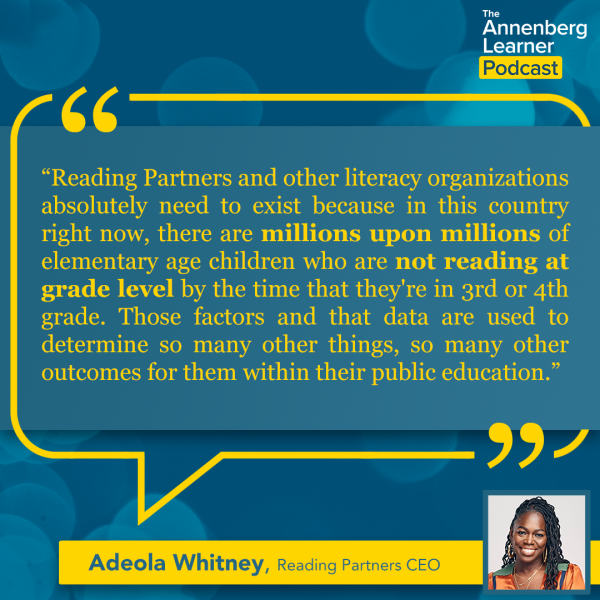
]]>Adeola “Ola” Whitney brings over 20 years of educational leadership experience to the CEO role of Reading Partners. Before being…
The post Episode 11: Reading Partners with CEO Adeola Whitney appeared first on Annenberg Learner.
]]>The post Episode 11: Reading Partners with CEO Adeola Whitney appeared first on Annenberg Learner.
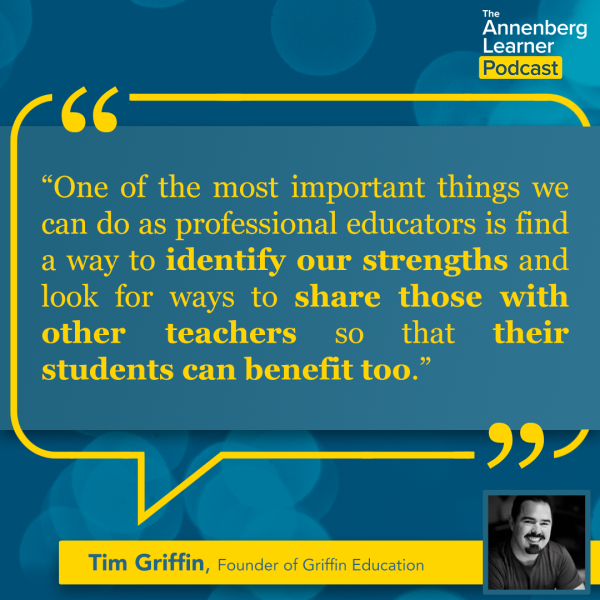
]]>After mostly paying his way through college and graduate school as a performing musician, Tim Griffin brought music to work…
The post Episode 10: Griffin Education with Tim Griffin appeared first on Annenberg Learner.
]]>The post Episode 10: Griffin Education with Tim Griffin appeared first on Annenberg Learner.
]]>Bruce Fuller, is a professor of Education and Public Policy at the University of California, Berkeley. He recently released When…
The post Episode 9: When Schools Work with Bruce Fuller appeared first on Annenberg Learner.
]]>The post Episode 9: When Schools Work with Bruce Fuller appeared first on Annenberg Learner.
]]>Growing up in the Echo Park community of Los Angeles to Cambodian immigrant parents, Chheav knows too well the adversity…
The post Episode 8: Best Buy Teen Tech Centers with Chheav Em appeared first on Annenberg Learner.
]]>The post Episode 8: Best Buy Teen Tech Centers with Chheav Em appeared first on Annenberg Learner.
]]>Annenberg Learner joined the AnnenbergTech team to celebrate the grand opening of the Best Buy Teen Center in South LA…
The post Annenberg Learner Celebrates Opening of South LA Teen Tech Center appeared first on Annenberg Learner.
]]>
The post Annenberg Learner Celebrates Opening of South LA Teen Tech Center appeared first on Annenberg Learner.
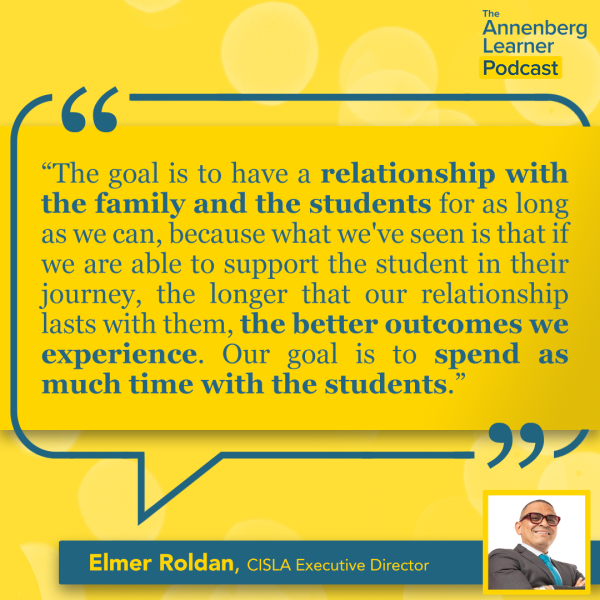
]]>Elmer Roldan is Executive Director of Communities in Schools Los Angeles (CISLA). Roldan is responsible for overseeing implementation of CISLA’s…
The post Episode 7: Communities In Schools Los Angeles with Elmer Roldan appeared first on Annenberg Learner.
]]>Annenberg Learner joined the AnnenbergTech team to celebrate the grand opening of the Best Buy Teen Center in South LA
The post Episode 7: Communities In Schools Los Angeles with Elmer Roldan appeared first on Annenberg Learner.
]]>Haydee Rodriguez is a National Board-Certified teacher, and bilingual and bicultural high school teacher who received her Bachelor’s in History…
The post Episode 6: Haydee Rodriguez – CA State Board of Education Member appeared first on Annenberg Learner.
]]>Annenberg Learner joined the AnnenbergTech team to celebrate the grand opening of the Best Buy Teen Center in South LA
The post Episode 6: Haydee Rodriguez – CA State Board of Education Member appeared first on Annenberg Learner.
]]>Rafael Cruz is a Los Angeles Unified School District Teacher at Hollenbeck Middle School and 2021-2022 Los Angeles County Teacher…
The post Episode 5: Rafael Cruz, LA County Teacher of the Year 2021-22 appeared first on Annenberg Learner.
]]>Annenberg Learner joined the AnnenbergTech team to celebrate the grand opening of the Best Buy Teen Center in South LA

During the month of April, Annenberg Learner and Step Up Tutoring will conduct the Annenberg Learner Spring Challenge, a recruitment
The post Episode 5: Rafael Cruz, LA County Teacher of the Year 2021-22 appeared first on Annenberg Learner.
]]>In 2020, over 30 STEM organizations came together to provide collaborative learning opportunities for Los Angeles students. As a result,…
The post Episode 4: Out of School Learning with Benjamin Dickow appeared first on Annenberg Learner.
]]>Annenberg Learner joined the AnnenbergTech team to celebrate the grand opening of the Best Buy Teen Center in South LA
During the month of April, Annenberg Learner and Step Up Tutoring will conduct the Annenberg Learner Spring Challenge, a recruitment
The post Episode 4: Out of School Learning with Benjamin Dickow appeared first on Annenberg Learner.
]]>Susanna Loeb is Director of the Annenberg Institute at Brown University, where she is also Professor of Education and Professor…
The post Episode 3: High-Impact Tutoring with Susanna Loeb appeared first on Annenberg Learner.
]]>Annenberg Learner joined the AnnenbergTech team to celebrate the grand opening of the Best Buy Teen Center in South LA
During the month of April, Annenberg Learner and Step Up Tutoring will conduct the Annenberg Learner Spring Challenge, a recruitment
The post Episode 3: High-Impact Tutoring with Susanna Loeb appeared first on Annenberg Learner.
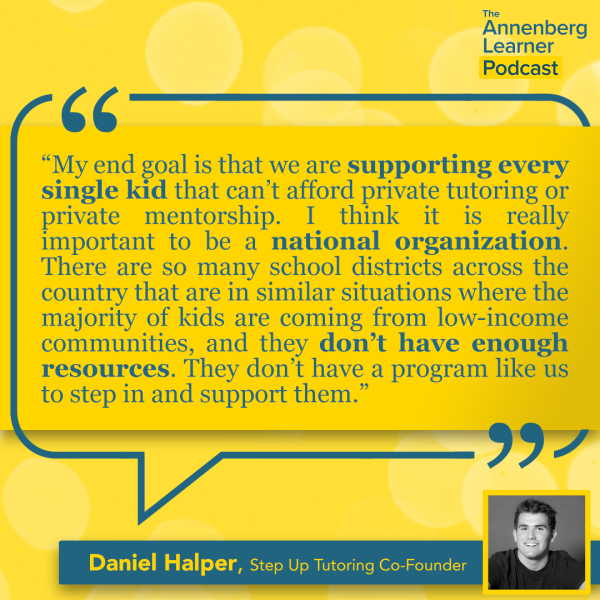
]]>Step Up Tutoring is a non-profit organization formed during the pandemic to deliver free, online tutoring. Since inception, Step Up…
The post Episode 2: Step Up Tutoring with Daniel Halper appeared first on Annenberg Learner.
]]>Annenberg Learner joined the AnnenbergTech team to celebrate the grand opening of the Best Buy Teen Center in South LA
During the month of April, Annenberg Learner and Step Up Tutoring will conduct the Annenberg Learner Spring Challenge, a recruitment
The post Episode 2: Step Up Tutoring with Daniel Halper appeared first on Annenberg Learner.
]]>In March 2020, Annenberg Learner partnered with Two Bit Circus to provide FREE STEAM-based online projects for K-12 students. The Annenberg Learner site contains over…
The post Episode 1: Two Bit Circus with Dr. Leah Hanes appeared first on Annenberg Learner.
]]>Annenberg Learner joined the AnnenbergTech team to celebrate the grand opening of the Best Buy Teen Center in South LA
During the month of April, Annenberg Learner and Step Up Tutoring will conduct the Annenberg Learner Spring Challenge, a recruitment
The post Episode 1: Two Bit Circus with Dr. Leah Hanes appeared first on Annenberg Learner.
]]>We track the lived experience of teachers, students, and parents alongside the organizations that serve them. Guest speakers share what’s…
The post The Annenberg Learner Podcast appeared first on Annenberg Learner.
]]>



The post The Annenberg Learner Podcast appeared first on Annenberg Learner.
]]>During the month of April, Annenberg Learner and Step Up Tutoring will conduct the Annenberg Learner Spring Challenge, a recruitment…
The post Annenberg Learner and Step up Tutoring Partner to Recruit Volunteer Tutors for Los Angeles Elementary Students appeared first on Annenberg Learner.
]]>During the month of April, Annenberg Learner and Step Up Tutoring will conduct the Annenberg Learner Spring Challenge, a recruitment drive organized by the Annenberg Foundation to pair educated and committed volunteer tutors with 3rd-6th grade students in the Los Angeles Unified School District for one-to-one, free online tutoring.
Volunteer tutors will provide sorely-needed guidance and mentorship to children who have suffered dramatic learning losses and isolation as a result of the COVID-19 pandemic. Twice a week, for an hour per session, volunteers will help students with their homework, encourage them in their studies, and help them feel more connected to their school communities.
Last year Step Up Tutoring matched over 700 LAUSD students with volunteer tutors. These volunteers completed over 10,000 hours of tutoring and received high levels of approval from teachers, parents, and students. 95 percent of parents rated their level of satisfaction with the program at a seven or higher, on a scale from one to ten. Since the beginning of the LAUSD program, over 1,400 volunteers have applied to be tutors.
The goal of the Annenberg Learner Spring Challenge is to increase the scope, reach and impact of Step Up Tutoring’s effort by bringing the number of students receiving free tutoring services to 1,000 by the end of the 2020-2021 school year. To help reach this goal, AnnenbergTech and PledgeLA, a collective of tech companies focused on diversity, equity, and community engagement, are also providing support, helping to secure commitments for over 100 volunteers from LA-based tech companies SNAP, FabFitFun, Bird, Soylent, HopSkipDrive, CAA, and more.
LAUSD schools gradually reopened beginning Monday, April 12th, after more than a year of online-only instruction. The district is following a hybrid schedule. Students can choose to either return to school, where they would receive in-person instruction for half of the day and then work independently online, or they can continue to log into class from home. Our goal is to recruit, vet and train 500 volunteer tutors and match them with students before the end of May. In order to do that, we’ll need your help.
“Many kids struggle with distance learning – especially the quiet and shy ones – and shut down,” said Irma Navarro, a 4th-grade teacher at Walnut Park Elementary School. “They are really happy to get the one-on-one help and I already see improvement in turning in assignments. I was really worried about one of my students because she was really shutting down, but now she can’t stop raving about her tutor. She really connected with her.”
A 2021 report by Great Public Schools Now titled “Educational Recovery Now” found that while daily engagement increased between the spring and fall of 2020, a third of LAUSD students were not actively engaged (“actively engaged” students are defined by LAUSD as “students who participated asynchronously that day by submitting an assignment, assessment, or posted to a discussion board”) and that large gaps across race, income and student need persist. Report findings show that more than 13,000 middle and high school students consistently disengaged in fall 2020 and an additional 56,000 did not actively participate on a daily basis. Two in three students are falling behind in literacy and math, with Black and Latino elementary school students falling the furthest behind.
Small-group and one-on-one tutoring have been shown to help students who have fallen behind in their studies. Research suggests that a large-scale initiative to make tutoring an integral part of public education would go a long way toward recovering the ground lost as a result of the pandemic. For the most part, however, one-on-one tutoring has been available only to those households with significant financial reserves. As the school closures dragged on, the demand for supplementary schooling grew, and the prices for private tutors rose out of reach of most public school parents.
“We can’t allow this pandemic to widen our educational divides even more,” said Wallis Annenberg, Chairman of the Board, President and CEO of the Annenberg Foundation. “That’s why this new partnership with Step Up is so important. Individual tutoring is one of the most powerful educational tools we have — a proven and effective way to engage our children, to lift up those who are being left out. We need to make it as available and accessible as possible. And we need to come out of this pandemic with all our children learning and achieving.”
Help spread the word! Prospective tutors may apply online through the Step Up Tutoring website, at stepuptutoring.org/annenberg. To be eligible, volunteers must be at least 18 years old, have completed or begun working toward an Associate’s or Bachelor’s degree, have reliable internet access, and reside in California.
If you are interested in becoming a volunteer tutor (or know someone else who is):
The post Annenberg Learner and Step up Tutoring Partner to Recruit Volunteer Tutors for Los Angeles Elementary Students appeared first on Annenberg Learner.
]]>As schools begin the process of reopening after the COVID-19 pandemic, learners and educators at every level are facing an…
The post The Education (Re)Open Turns to Global Community for Solutions to Educational Challenges appeared first on Annenberg Learner.
]]>As schools begin the process of reopening after the COVID-19 pandemic, learners and educators at every level are facing an array of challenges, old and new. The process of recovering from the social change of the past year will require an unprecedented level of innovation, and the involvement of everyone who has a stake in the future of education.
Annenberg Learner is proud to help drive much-needed innovation by joining the ranks of organizations supporting The Education (Re)Open, an OpenIDEO program designed to crowdsource solutions to the numerous educational challenges facing students, parents and educators as a result of the COVID-19 pandemic.
A collaboration between the Center for Engagement-Driven Global Education (EDGE) at the USC Rossier School of Education, the Andrew Nikou Foundation and IDEO, The Education (Re)Open is a public-facing solicitation for answers to the question, “How might we strengthen school communities, as sites reopen, by highlighting solutions that reconnect people and enhance collective wellbeing, teaching, and learning?”
The Education (Re)Open will accept solutions until May 14th from anyone with a stake in the evolution of K-12 education. During this first “Open Call” period, participants may refine the ideas they have submitted. Submissions are visible to the public, and will receive written feedback by the coaches and education specialists involved in the (Re)Open project. On May 17th, the Review phase begins, where judges from (Re)Open partner organizations and the Los Angeles educational community will evaluate and discuss each potential solution. Winning submissions will be added to The Solutions Exchange, a public repository of ideas, advice and strategies designed to help school communities thrive amidst unprecedented social changes and will be available to a global audience of educators, administrators and scholars who are ready to use them to enrich their own communities.
Submissions should address one of the following themes:
Communities Reconnecting
Collaborative Teaching, Learning, and Leadership
Collective Health and Well-being
For additional information, take a look at the following resources:
Participants whose ideas are featured on The Solutions Exchange will be eligible to win $1000 prizes. Winning submissions will be announced during the launch of The Solutions Exchange, which will go live the week of June 7, 2021.
Visit the Education (Re)Open page at OpenIDEO to submit your solution!
The post The Education (Re)Open Turns to Global Community for Solutions to Educational Challenges appeared first on Annenberg Learner.
]]>The Los Angeles Unified School District (LAUSD), Discovery Education, and Annenberg Learner today announced a new partnership providing educators, students…
The post Annenberg Learner Teams Up with LAUSD and Discovery Education to Launch New Partnership appeared first on Annenberg Learner.
]]>The Los Angeles Unified School District (LAUSD), Discovery Education, and Annenberg Learner today announced a new partnership providing educators, students and families access to high-quality digital resources, furthering our commitment to adaptive and enriching education during the unprecedented disruption of the global COVID-19 pandemic. From the press release:
“We all face a critical challenge as the pandemic continues,” said Wallis Annenberg, Chairman and CEO of the Annenberg Foundation. “How do we keep bolstering dynamic digital education content when so many children are learning at home – while also opening new doors to learning for everyone? This is something our foundation’s been engaged in for many decades now, especially with our Annenberg Learner initiative. That’s why I’m so proud to be helping Discovery and the LA public schools in this important endeavor, and making Learner’s incredible resources available to them.”Read the full press release.
Discovery Education will incorporate Annenberg Learner content into Discovery Education Experience, which will enable even more educators, students and parents across the country the opportunity to engage with Annenberg Learner’s educational content.
To help educators integrate their new digital resources into instruction in the coming school year, Discovery Education will provide Los Angeles Unified teachers dedicated professional learning. Through these interactive professional development sessions, participants will learn best practices for using their new digital resources. Effective professional development will maximize the power of these digital resources, increase student engagement in instruction and support students’ continued academic development.
The post Annenberg Learner Teams Up with LAUSD and Discovery Education to Launch New Partnership appeared first on Annenberg Learner.
]]>Even in the best of times, the planning and execution of an engaging lesson for a classroom full of students…
The post Zoom and Data Privacy appeared first on Annenberg Learner.
]]>Even in the best of times, the planning and execution of an engaging lesson for a classroom full of students is a difficult task. The response to the COVID-19 pandemic has required educators to rethink their lesson planning in order to conduct classes remotely. Teachers still must deal with classroom management issues. They must still work to measure each student’s absorption of the material and their ability to put that information to use. Added to this, educational organizations of all kinds are working to develop systems that safeguard the online privacy of their students.
The Family Educational Rights and Privacy Act, or FERPA, sets guidelines for the handling of student educational records. In the context of the law, the term “educational records” covers student work and the evaluation of that work, but also includes any identifying information about each student, including their images, their digital and physical addresses, and their chat logs. FERPA applies to educational institutions that receive funding of any kind from the Department of Education. Zoom’s video conferencing service, with its capacity for large numbers of users and numerous options for customizability, has been widely adopted by learning institutions. It’s proven to be a useful tool for connecting students and preserving a large part of the classroom experience. If you’re planning to run a class via Zoom, there are easy ways to modify your online classroom practices to satisfy FERPA’s requirements.
Handling Student Data
Recording class sessions: When in doubt? Don’t.
Zoom makes it easy for hosts and participants to record class sessions. While it is useful to have a record of the class, each session will contain images of your students, along with identifying information about each of them. You’ll need permission from each student in order to record a class session. You’ll also need permission in order to use or share the recording anywhere outside of class. Once the recording has been shared, it, like everything on the internet, is now outside of your control. The safest approach, in terms of student privacy, is to refrain from recording class sessions entirely.
Disable Private Chat: Keeping students on-task
You can adjust the settings of the Chat feature to allow messages between students and the host, but not between students. Aside from helping to focus their attention, disabling private chat will also keep the content of the chat logs on-topic and less likely to contain sensitive information.
Virtual Office Hours: Some conversations should happen off-line.
Students may need to discuss topics with you or with classmates that involve revealing personal and/or sensitive information. It’s best to find ways to keep these conversations off of Zoom. Conducting regular virtual office hours via phone or private chat is a way to set aside time for sensitive teacher-student conversations. For student interactions, it’s worth reminding them regularly that anything typed into a chat window can potentially be shared with the world at large.
Preventing Outside Interference: Making Sure Everyone Is Who They Say They Are
While it’s fair to say that everyone registered for your class has the interests of the students in mind, the same can’t necessarily be said for outside actors. That’s why it’s important to make sure that everyone in your Zoom meeting is actually a student.
Use unique meeting IDs
Zoom assigns each user a unique, unchanging Personal Meeting ID. Anyone possessing that ID can join your meeting without an invitation, so it’s safer to generate a new Meeting ID for your class. Even better: create new Meeting IDs regularly, ideally one for each class meeting. Send that new ID to your students ahead of time via email. Don’t publish the ID in public spaces or on social media. Make sure to remind your students to keep the Meeting ID private.
Use Waiting Room to verify registration
Zoom’s Waiting Room feature, now enabled by default, will allow you to confirm the identity of each student before admitting them to your meeting. Confirm that the Join Before Host feature is disabled to ensure that no one can enter before you’re ready. Make sure that your students know that their Zoom account names must match the names on your registration report before they can be admitted. For an additional level of security, require that students enter a password for entry into the Waiting Room. Once everyone on your list is in the meeting, lock the room.
Involving Students in the Process
Setting Norms: Make data security a regular and expected part of student orientation.
Learning about responsible Internet citizenship is now part of the process of growing up. Just as in a physical classroom, a safe and efficient learning environment requires a clear structure of guidelines for behavior, and the participation of students in supporting and enforcing that structure. Make data security protocols part of the ground rules of classroom behavior. Remind your students regularly about rules against taking screenshots of class members, or of sharing chat logs, for instance.
Zoom’s service was not designed to protect data privacy, but rather to enable large numbers of people to communicate at once. Nevertheless, their developers have responded to user feedback with multiple updates to make their service safer and easier to use. Take a look at their blog for announcements to changes in Zoom’s policies or interface.
Additional Resources
The post Zoom and Data Privacy appeared first on Annenberg Learner.
]]>This column originally appeared in a special section of USA Today and at Education and Career News. As teachers and parents have had…
The post The Revolutionary Power of Television in Education appeared first on Annenberg Learner.
]]>As teachers and parents have had to treat yet another symptom of the coronavirus — the need for kids to be schooled at home — one of the most potent solutions has turned out to be decidedly old school: television.
Despite all the advances in hi-tech online learning taking place around the country, school districts from New York to California, Alabama to Wyoming, and North Dakota to Texas are now providing remote learning opportunities through educational television programming and partnerships with public TV stations.
That’s not just nice, it’s necessary. Pew Research reports that more than 40 percent of American families with incomes less than $30,000 have no broadband access whatsoever. And even if they did, the American School Superintendents Association says, most school districts “don’t have the ability to provide continuous virtual online instruction.”
But the U.S. Census Bureau says 98 percent of American households do have at least one television. They also report more than 100 million households view programs on PBS television each month, and that includes 77 percent of all children ages 2 to 8.
For the Annenberg Foundation, using TV to provide free and equal access to education is in our DNA. Our founder, newspaper publisher, and television station owner Walter Annenberg was passionate about the idea of using TV to teach. So he premiered two shows on his Philadelphia TV station — Studio Schoolhouse in 1947 and University of the Air in 1951 — winning the prestigious Alfred I. DuPont Award for pioneering education via television.
Mr. Annenberg went on to develop even more radio and TV curricula for K-12 kids, college students, and teachers. Over the years, these were made available through a long-time partnership with the Corporation for Public Broadcasting.
Then, as the internet began to explode, Mr. Annenberg’s vision for widely accessible and free education went online with our initiative called Annenberg Learner, which funds educational video programs. Our website www.learner.org distributes a wide range of free multimedia resources for students in K-12 classrooms and for teachers’ professional development.
These days, when distance learning has become not just an extracurricular but a necessity — and recognizing that so many students can’t access Learner materials on the internet at home — we’ve gone back to our own Annenberg roots in television. We’re providing free broadcast licenses to any school district that wants to educate their students or supplement online learning via television. In addition, Annenberg Learner is adding cutting-edge, media-rich content from new partners, such as Two Bit Circus Foundation, to provide programs for students in STEM plus the Arts (STEAM).
Mr. Annenberg’s longtime vision of free, equitable, and permanent access to education for all has never been more relevant than today, especially given our technologically elaborate and expensive system of information and communication is only accessible by the economically privileged.
Walter Annenberg believed — as does his daughter and current Annenberg Foundation Chairman Wallis Annenberg — that every child has an equal right to education. And if he were here today, he’d be saying loud and clear that this is our moment to harness every aspect of technology — both old and new, both high-tech and low-tech — to ensure all of America’s kids have free access to a good education. Even at home.
Cinny Kennard
Executive Director, Annenberg Foundation
The post The Revolutionary Power of Television in Education appeared first on Annenberg Learner.
]]>Over 150 Innovative Experiments Available For Educators, Kids, and Families Throughout the Summer and School Year LOS ANGELES – (May 28,…
The post Press Release: Annenberg Foundation and Two Bit Circus Foundation Ignite Lifelong Love for Arts and Sciences with Free STEAM-Based Online Projects appeared first on Annenberg Learner.
]]>Over 150 Innovative Experiments Available For Educators, Kids, and Families Throughout the Summer and School Year
LOS ANGELES – (May 28, 2020) – Two Bit Circus Foundation, a nonprofit educational organization, announced today it is collaborating with the Annenberg Foundation’s educational division, Annenberg Learner, to provide free access to over 150 hands-on science, arts, and tech projects designed for educators, parents, and children across the country and around the world. This decision to introduce STEAM (science, technology, engineering, art, and math) content on Learner.org is in direct response to the overwhelming need for creative and accessible STEAM resources during this unprecedented global crisis. The projects are a solution for continuing student education during the summer and academic school year.
Two Bit Circus Foundation has been creating innovative STEAM content for over a decade. The COVID-19 crisis accelerated the collaboration between Annenberg Learner and Two Bit Circus Foundation, both of whom are passionate about providing educational access to students and educators, and sparking a lifelong love for the arts and sciences. The new STEAM projects are all standards-aligned and come in easily digestible formats for educators, parents, and children to follow using found objects.
Available projects include:
“Education needs a revolution,” said Dr. Leah Hanes, CEO of Two Bit Circus Foundation. “Our current situation is pushing us to find new ways of teaching to engage children and help them take agency over their own learning. We’re excited to have Annenberg Learner, a leader in advancing education, share our hands-on curriculum to their wide range of followers, inspiring the next generation of inventors.”
For nearly three decades, Annenberg Learner has funded and distributed multimedia resources for K-12 classroom instruction and teacher professional development. And now, as schools across the country shift to distance learning amidst the effects of COVID-19, Annenberg Learner’s users need more offerings for digital environments, and more project-based learning opportunities. Two Bit Circus Foundation has already seen a positive increase across its online platforms, turning its Twitch channel into daily hands-on maker sessions for students and parents to learn more about STEAM fundamentals, making them an ideal partner.
“Annenberg Learner and its wide range of multimedia educational resources continue to meet the critical needs of students and educators, whether they are schooling in a classroom or at home,” said Cinny Kennard, Executive Director, Annenberg Foundation. “With the addition of Two Bit Circus Foundation’s innovative and fun STEAM program, we are able to provide a high-quality, comprehensive learning experience and valuable content for parents desperate for summer projects that will help spark creativity and love of learning.”
To check out the more than 150 free STEAM based projects now available online, visit Annenberg Learner’s site at https://learner.org/twobitcircusorg.
About the Foundation, Powered by Two Bit
Two Bit Circus Foundation, a 501(c)(3) nonprofit organization, is on a mission to increase access to STEAM education opportunities in communities around the world. A collection of successful STEAM-based programs including Imagination.org, LA Makerspace, Trash for Teachers, and STEAM Carnival, Two Bit Circus Foundation aims to cultivate the next generation of inventors, advance environmental stewardship, and spur community engagement by providing schools and youth of all means with access to hands-on STEAM learning, modern maker tools, and upcycled materials.
Architected for maximum social impact, the organizations are able to expand STEAM education programs worldwide, bringing makerspaces, STEAM Labs, Imagination Chapters, STEAM Carnivals, Cardboard Challenges sparked by Caine’s Arcade, and more to schools, libraries, and at-risk communities worldwide. Imagine a world where creativity and entrepreneurship are core social values nurtured in schools, homes, and communities everywhere, where all children are taught to be creative thinkers and doers, and encouraged to make their very best ideas happen.
For more information, visit www.twobitcircus.org or follow @TwoBitCircusorg and #TwoBitCircus.
About Annenberg Learner
Annenberg Learner is the education division of the Annenberg Foundation, created to advance excellent teaching in American schools. For more than three decades, Annenberg Learner has pursued this mission by funding and distributing multimedia resources, including video, print, and web materials, for the professional development of teachers (K-12 and college levels). These resources in all discipline areas help teachers to stay up-to-date in their fields and to use current learning research in their classrooms. More than 100 multimedia courses and workshops are streamed free through http://www.learner.org. As the name Annenberg Learner implies, its focus is on the teacher, as well as the student, as a learner.
###
The post Press Release: Annenberg Foundation and Two Bit Circus Foundation Ignite Lifelong Love for Arts and Sciences with Free STEAM-Based Online Projects appeared first on Annenberg Learner.
]]>Annenberg Learner programming will reach 45,000 local students through NOLA-PS TV NEW ORLEANS – (May 18, 2020) – NOLA Public Schools (NOLA-PS) and…
The post Press Release: NOLA-PS Partners with Annenberg Foundation to Provide Free Educational Programming to Families and Teachers appeared first on Annenberg Learner.
]]>Annenberg Learner programming will reach 45,000 local students through NOLA-PS TV
NEW ORLEANS – (May 18, 2020) – NOLA Public Schools (NOLA-PS) and the Annenberg Foundation have partnered to broadcast Annenberg Learner programming on NOLA-PS TV free of charge to help support continued distance learning needs over the summer impacting over 45,000 local students in light of the COVID-19 public health crisis. The Annenberg Learner content collection contains K-12 educational materials and videos covering a variety of subjects from math and science to literature and music.
Starting today, the Annenberg Learner programming can be accessed at: https://nolapublicschools.com/opsb-tv or NOLA-PS TV on channel 8 via COX Cable now through July 31, 2020.
“I’d like to thank Annenberg Foundation for giving our families and teachers the opportunity to experience this educational programming, free of charge to fill distance learning needs,” said NOLA-PS Superintendent of Schools Dr. Henderson Lewis, Jr. “The Annenberg Learner content is a great way for our students to continue their educational growth, especially during the upcoming summer break. We truly value this partnership and look forward to the entire NOLA-PS community utilizing this content.”
Families and teachers will benefit from some of Learner’s most popular series including The Habitable Planet: A Systems Approach to Environmental Science which explores the natural functions of Earth’s systems and Earth’s ability to sustain life, and Against All Odds: Inside Statistics which shows the relevance of statistics in real-world settings. In the American Cinema series, over 150 Hollywood insiders document American culture through film. Additionally, The Constitution: That Delicate Balance series is a timely resource that probes beliefs and biases about the Constitution.
“Broadcasting Learner programming via television ensures that all students, whether or not they have access to a computer or an Internet connection, can continue their education remotely as we redefine what learning looks like during this crisis,” said Cinny Kennard, Executive Director, Annenberg Foundation. “Annenberg Learner has always known it is critical for teachers to have access to educational materials that supplement their curricula to create deeper learning connections with their students, educators in the midst of a global pandemic are certainly no exception.”
Annenberg Learner – Week 1 – Daily Schedule
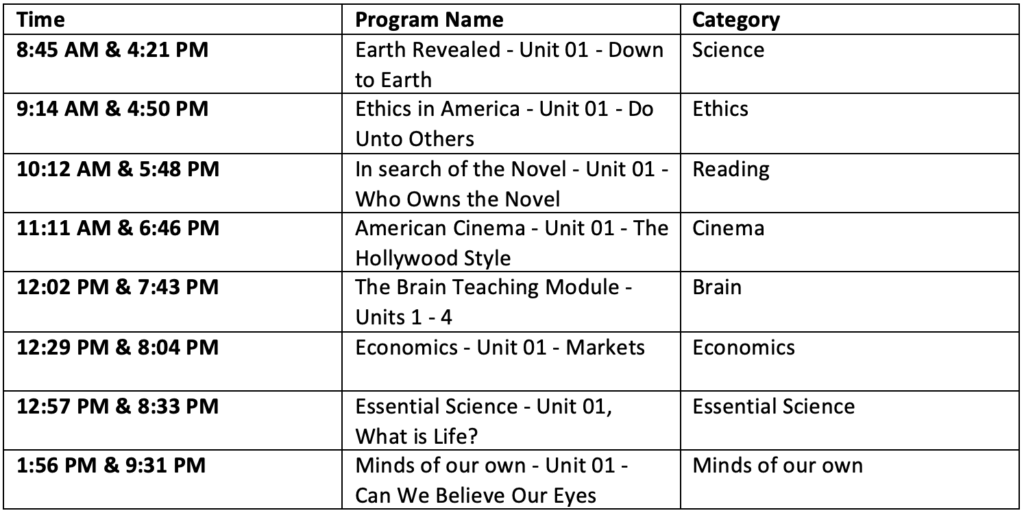
To access the Annenberg Learner weekly programming schedule now through July 31, 2020 on NOLA-PS TV visit www.nolapublicschools.com.
The Annenberg Foundation is making Annenberg Learner programming available free of charge to any school district in the country to assist with distance learning. Annenberg Learner also has free content resources and coordinated online materials, such as user guides, downloadable textbooks, labs and interactives, that can be used directly at www.learner.org.
###
ABOUT NOLA PUBLIC SCHOOLS:
NOLA Public Schools is the public school district for Orleans Parish, which includes the district’s elected school board, known as the Orleans Parish School Board and the district’s administration led by NOLA Public Schools Superintendent Dr. Henderson Lewis Jr. NOLA Public Schools currently oversees 78 public schools. For more information visit www.nolapublicschools.com. For updates, follow NOLA Public Schools on Facebook @NolaPublicSchools, Instagram @nolaps and Twitter @NOLAPSchools.
ABOUT ANNENBERG LEARNER:
Annenberg Learner is the education division of the Annenberg Foundation, created to advance excellent teaching in American schools. For more than three decades, Annenberg Learner has pursued this mission by funding and distributing multimedia resources, including video, print, and web materials, for the professional development of teachers (K-12 and college levels). These resources in all discipline areas help teachers to stay up-to-date in their fields and to use current learning research in their classrooms. More than 100 multimedia courses and workshops are streamed free through http://www.learner.org. As the name Annenberg Learner implies, its focus is on the teacher, as well as the student, as a learner.
The post Press Release: NOLA-PS Partners with Annenberg Foundation to Provide Free Educational Programming to Families and Teachers appeared first on Annenberg Learner.
]]>The COVID-19 pandemic has many of us thinking about infectious disease, and how our individual choices affect the health and…
The post Resources to Frame Discussions of COVID-19 appeared first on Annenberg Learner.
]]>The COVID-19 pandemic has many of us thinking about infectious disease, and how our individual choices affect the health and welfare of our communities.
This week, we’re featuring several series that discuss the intersection of community and health, with content that you can use to frame lessons about COVID-19.
Rediscovering Biology: Molecular to Global Perspectives is a series about recent developments in science designed for high school biology teachers. Produced in 2003, Rediscovering Biology is a snapshot of the state of the life sciences at the beginning of the 21st century. The Emerging Infectious Diseases unit describes how viruses and bacteria infect human beings and cause illnesses. The lessons it teaches are as powerful as ever. It talks about how scientists fight their spread, and how we can change our habits in order to protect ourselves. The series combines interviews with experts in the fields of medicine, genomics, microbiology and biophysics. Together, these experts survey the efforts of the public health community to understand and contain the reemergence of diseases that many of us thought had been beaten by modern medicine:
The Habitable Planet: A Systems Approach to Environmental Science is designed for high school science teachers and undergraduate students. Produced in 2007, its Human Population Dynamics unit examines how increasing population density, climate change and patterns of human consumption affect the quality of our lives. It is a particularly relevant series for this Earth Day week, as the challenges we face have only grown.
Disease Lab is an interactive activity contained within the Habitable Planet series. Part of the Human Population Dynamics unit, Disease Lab shows how the ways in which people interact with each other can affect the severity and breadth of an epidemic. Users can modify the population density, level of social interaction, and vaccination rate of a simulated population. They can then record the rates of death, immunity, and infection that result after exposure to a set of fictional diseases such as Kold, Neasles, or Impfluenza.
Against All Odds: Inside Statistics is a video series that uses practical examples from a variety of disciplines to illustrate the principles of statistics. In Inference for Two-Way Tables, Dr. Pardis Sabeti, a computational geneticist at Harvard University, studies outbreaks of Lassa fever in West Africa. While examining the phenomenon of genetic resistance to disease, she notes that children born with the non-expressing gene for Sickle-cell disease also seem to have a resistance to malaria. Pardis uses a two-way table to compare the hemoglobin genes of children suffering from malaria, in order to determine whether the apparent connection between Sickle-cell disease and malaria resistance is statistically significant.
Additional Resources for Teaching About Infectious Diseases and COVID-19:
The post Resources to Frame Discussions of COVID-19 appeared first on Annenberg Learner.
]]>A message for K-12 teachers, students, parents and guardians: We hope that you are staying safe. While schools are closed due…
The post Free K-12 Educational Resources (online and for noncommercial broadcasting) appeared first on Annenberg Learner.
]]>A message for K-12 teachers, students, parents and guardians: We hope that you are staying safe. While schools are closed due to the coronavirus (COVID-19), many of you will be looking for online materials so that your students can continue learning while at home. As many of you know, Annenberg Learner has free content resources you can use directly from www.learner.org. Search classroom resources by grade levels and subject areas. Some video resources also include coordinated online materials, such as user guides, downloadable textbooks, labs and interactives, and more. Or look at the full list of available content and professional development resources, under Series Availability in our FAQ. You can also find Annenberg Learner and other great resources through PBS Learning Media.
Please write info@learner.org with any questions. We will also continue to share information about available resources from our partners below. We hope everyone stays healthy.
Attention Noncommercial Broadcasters: In addition to the free K-12 resources online, Annenberg Learner is providing temporary noncommercial broadcast licenses to local networks across the U.S. This programming for K-12 audiences includes 23 Annenberg Learner video series. Here is the list of what is available for a temporary broadcast license through July 31, 2020. Please contact info@learner.org if you are interested in licensing any or all of these series.
From BAM! Radio: As schools rapidly move to online Learning, listen to educators, administrators, and IT managers talk about successes and challenges.
Explore.org
We have compiled teacher lesson plans around our nature livecams created by researchers and animal experts. In addition to these incredible FREE lesson plans, explore.org is always available as an enriching educational experience through the use of our many livecams. Our volunteer moderators and camera operators are always available to answer any questions your child may have while diving deep into the world of nature.
In addition to serving as educational resources for teachers and students, explore.org would like to offer its live streams and footage to help anyone looking to escape stress and find solace in the natural world. Continue to fall in love with the world and feel free to share our feeds with anyone who needs to escape and connect with the natural world.
Though this time is hard, we are here for each other and together. Nature can heal us and make us stronger!
Civics Renewal Network Partner Resources
These resources cover grades K-12 and offer a variety of activities to keep students engaged in learning outside the classroom. Please check back often as we will continue to add resources.
Statistics in Schools (SIS)
SIS is a U.S. Census Bureau program that uses census data to create resources that can be used with students from pre-K through 12th grade. These free, online educational resources can easily be used at school or at home. The SIS website offers more than 200 free activities and resources, including interactive data tools, videos, and maps. Explore these materials at www.census.gov/schools. SIS materials are easy to follow and do not require any special skills to use. This makes them a great resource for parents and guardians to use at home
Smithsonian Digital Learning Lab
Resources, training, and support to assist caregivers, teachers, and students as they face new learning challenges: The Smithsonian Learning Lab puts the treasures of the world’s largest museum, education, and research complex within reach. The Lab is a free, interactive platform for discovering millions of authentic digital resources, creating content with online tools, and sharing in the Smithsonian’s expansive community of knowledge and learning.
The post Free K-12 Educational Resources (online and for noncommercial broadcasting) appeared first on Annenberg Learner.
]]>(updated 1/30/2020) We are excited to announce our new and improved Annenberg Learner website. Featuring a more user-friendly experience, simplified…
The post It’s Here! You’re Viewing the New Annenberg Learner Website! appeared first on Annenberg Learner.
]]>
(updated 1/30/2020) We are excited to announce our new and improved Annenberg Learner website. Featuring a more user-friendly experience, simplified search, and filtering features that will quickly lead you to the content you want, it’s the Annenberg Learner you already love – now even better!
To ease the transition to our new site, Learner content will remain available on the old site and new simultaneously. That said, we highly encourage you to check out the new site and use the content featured there when appropriate. Our old site will remain available as archive.learner.org until February 29, 2020.
Let’s get started! Visit the homepage to check out available series and search key words.
Series now available :
And more!
We have a handful of series left to migrate and some dusting up to do. Links are provided to the archive site while we finish up.
We hope you enjoy the new improved site, and invite your feedback at info@learner.org.
–Team Annenberg Learner
P.S. From time to time, our series license rights expire. As always, view the updated list of discontinued series in our FAQs. Please sign up for our newsletter for the latest information on any changes.
The post It’s Here! You’re Viewing the New Annenberg Learner Website! appeared first on Annenberg Learner.
]]>For 25 years, Annenberg Learner has been a proud partner and funder of Journey North. As a pioneer of online education – and…
The post Exciting News for Journey North! appeared first on Annenberg Learner.
]]>
When our trusted partner, Journey North founder Elizabeth Howard, announced she would be stepping down at the end of the year, we both felt strongly that we needed to find the ideal academic partner to sustain and grow the initiative. Through the search, together we identified the University of Wisconsin-Madison Arboretum (UW).
We are excited to share that effective February 5, 2019, Journey North will transfer ownership to UW and be led by Dr. Karen Oberhauser. As the nation’s preeminent monarch butterfly scientist and a leader in national and international conservation efforts, Dr. Oberhauser is uniquely positioned to lead Journey North moving forward. She is co-chair of Monarch Joint Venture, which has more than 70 organizations under its umbrella and was recognized with the White House Champion for Change award for citizen science in 2013. We are confident Journey North will be in good hands.
Annenberg Learner remains committed to Journey North’s mission and will proudly support Journey North at UW-Madison Arboretum in the future. You will continue to be able to access the site through learner.org or at journeynorth.org. Share your experiences on social media with #ThankYouJourneyNorth.
Read more about the announcement on the University of Wisconsin-Madison website.
The post Exciting News for Journey North! appeared first on Annenberg Learner.
]]>On Sunday May 19, LAUSD students, families, teachers, and community members gathered at the Two Bit Circus Micro-Amusement Park in…
The post Games for Change Student Challenge Los Angeles 2019 Celebration! appeared first on Annenberg Learner.
]]>Student finalists share their games at an arcade at the Two Bit Circus Micro-Amusement Park. Photo Credit: Annenberg Foundation
The post Games for Change Student Challenge Los Angeles 2019 Celebration! appeared first on Annenberg Learner.
]]>By Lilly Strieder (guest contributor) When I think of the teachers that have inspired both me and my education, two…
The post Teacher Appreciation: Defying Gravity- Teachers Who Keep Reaching appeared first on Annenberg Learner.
]]>The post Teacher Appreciation: Defying Gravity- Teachers Who Keep Reaching appeared first on Annenberg Learner.
]]>PLEASE NOTE: Availability of Annenberg Learner series and student interactives is subject to change. We will provide advance notice in…
The post List of Recent Series Discontinuations appeared first on Annenberg Learner.
]]>PLEASE NOTE: Availability of Annenberg Learner series and student interactives is subject to change. We will provide advance notice in our newsletter, on the Learner.org website, and on our Facebook and Twitter pages.
Also, we receive many questions about purchasing copies of discontinued series. We no longer sell DVDs and corresponding materials, and once a series is discontinued, we no longer have the rights to distribute it in any format. Whenever possible, we will provide a link to where the series can still be accessed or info about the original producer if not distributed elsewhere. See the Series Availability info in our FAQs.
The following series were discontinued on Learner.org on June 25, 2019.
SERIES TITLES
America’s History in the Making
Artifacts & Fiction
Learner Express: Literature modules
Learner Express: Mathematics: Common Core Standards PD Modules
Learner Express: STEM: Earth and Space Science
Learning Science Through Inquiry
Literary Visions
The Mind
The Missing Link
Power of Music
Primary Sources
Private Universe Project in Mathematics
Private Universe Project in Science
Reactions in Chemistry
Science in Focus: Energy
Science in Focus: Force and Motion
Seasons of Life
Surprises in Mind
The World if Chemistry (check out our newer series Chemistry: Challenges and Solutions)
STUDENT INTERACTIVES
Math in Daily Life
Metric Conversions
Statistics
Historical and Cultural Contexts
Literature
Cinema
Collapse
DNA
Garbage
Volcanoes
Weather
The following series were discontinued on Learner.org on December 31, 2018. (Browse our list of resources for other series that may be of interest to you.)
Calculating Change
Rural Communities
School Testing- Behind the Numbers
Teaching Geography
Mathematics Assessment
Teaching Math K-2
Teaching Math 3-5
Teaching Math 6-8
Teaching Math 9-12
Teaching Math K-4 Library
Teaching Math 5-8 Library
Teaching Math 9-12 Library
The post List of Recent Series Discontinuations appeared first on Annenberg Learner.
]]>Who says writing novels is just for the adults? November is National Novel Writing Month, when the nonprofit NaNoWriMo challenges…
The post You Don’t Have to Be an Adult to Write a Novel appeared first on Annenberg Learner.
]]>Who says writing novels is just for the adults? November is National Novel Writing Month, when the nonprofit NaNoWriMo challenges adults and children around the world to channel their inner novelist to write that first draft by the end of the month. Students and educators may sign up through NaNoWriMo’s Young Writers Program. Online resources allow students to keep track of their word count and provide prompts and tips to keep creative juices flowing.
Add the following Annenberg Learner programs to your list of novel-writing resources:
Where do novels come from? After watching workshop 4 of In Search of the Novel, you will be equipped to create a lesson plan that helps students develop their own stories by connecting imagination, experience, and reflection.
It’s easy to think that professional writers just sit down and write a perfect piece on their first attempt. So why does it feel so hard when we (and our students) try to get something, anything, down on paper? One writing strategy is imitation. In workshop 7 of Developing Writers, students read works by different professional writers and then write by imitating the voices of those authors. This imitation helps students develop their own voice by building their confidence.
Younger students learn about the crucial elements that make up a story using the fairytale Cinderella in an online interactive. Students explore the function of characters, conflict, and resolution as they break apart this well-known childhood story.
Image: bluelela / 123RF Stock Photo
The post You Don’t Have to Be an Adult to Write a Novel appeared first on Annenberg Learner.
]]>On Saturday June 2, LAUSD students, families, teachers, and community members gathered at Cross Campus in downtown LA to celebrate…
The post Celebrating the Games for Change Student Challenge LA Finalists and Winners appeared first on Annenberg Learner.
]]>Student finalists in their Games for Change shades with Anjali Bhimani. Photo credit: Annenberg Foundation
On Saturday June 2, LAUSD students, families, teachers, and community members gathered at Cross Campus in downtown LA to celebrate the finalists for the Games for Change Student Challenge in Los Angeles. This is the third annual Games for Change Student Challenge. The Annenberg Foundation, Annenberg Learner, and AnnenbergTech sponsored the G4C Student Challenge in Los Angeles, the first west coast presence of the competition and program. Read about the 2017-18 program in this post.
Students share their video games in the Games for Change Arcade. Photo Credit: Annenberg Foundation
Almost 200 games were submitted in Los Angeles and judged in three rounds. Jurors included industry professionals from DICE and Riot Games, Los Angeles-area nonprofit organizations and theme partners, and volunteers studying game design in universities.
Finalists, winners, and their teachers received cool prizes provided by the Annenberg Foundation, National Wildlife Federation, Born This Way Foundation, Common Sense Education, Entertainment Arts, and Games for Change.
Students share their video games in the Games for Change Arcade. Photo Credit: Annenberg Foundation
The ceremony opened with an arcade of the finalists’ games. Families and community members played the video games and talked with the students.
Then actress Anjali Bhimani emceed an Awards Ceremony. Allison Holmes from the Annenberg Foundation and Susanna Pollack from Games for Change kicked off the ceremony by welcoming the students and guests and explaining the program this year. Anjali presented awards for each theme category, alongside representatives from the National Wildlife Federation and Common Sense Education.
Emcee Anjali Bhimani, who voices Symmetra in Overwatch, leads the show! Photo Credit: Annenberg Foundation
The winners were called on stage to receive their trophies and answer questions from Anjali about their games. Susanna Pollack presented each of the grand prize winners with a $1000 scholarship from Take-Two Interactives. The Annenberg Foundation also gave a bonus $100 to all 32 finalists.
Below is the list of finalists and their games! Congratulations to students and their teachers!
Keep an eye on the Games for Change Student Challenge website to view and play the winning games.
High School
Kindness & Empathy
The Stress Quiz, by Kiev G. and Christopher B. from STEM Academy of Hollywood (WINNER)
Rescue Mission, by Seth G., Naja M. and Raquel S. from STEM Academy of Hollywood
Wildlife Conservation
Cougar, by Naomi M. of Girls Academic Leadership Academy (WINNER)
Student Naomi with Amanda from the National Wildlife Federation and Anjali. Photo Credit: Annenberg Foundation
Save the Cougars of LA, by Brayan G. and Ivan P. of STEM Academy of Hollywood
Roadkill Escape, by Alyssa L. of STEM Academy of Hollywood
News Literacy
News to You, by Stephanie R. and Louis P. of STEM Academy of Hollywood (WINNER)
Middle School
Kindness & Empathy
Me, My Friends, and I, by Devin L. of Florence Nightingale Middle School (WINNER)
Translove, by Jolette A., Jesus G., Odyssey H., Victoria H. of South Gate Middle School
Kindness, by Juan R. of Francisco Sepulveda Middle School
Kindness, by Osckar L. of Francisco Sepulveda Middle School
Kinthy, by Fabiola F., Emily A., Andrea G., and Pamela A. of South Gate Middle School
The Grand Prize winners pose with their teacher, Mr. Gendernalik, and families! Photo Credit: Annenberg Foundation
Wildlife Conservation
Mountain Lion Maze of Life, by Isaac T. and Jomo H. of William Mulholland Middle School (WINNER and GRAND PRIZE)
The Journey of P-22, by Cesar S. of Francisco Sepulveda Middle School
Dodge the Predator, by Lluvia C. of Florence Nightingale Middle School
News Literacy
Gossip!, by Celeste V., Phoebe C., Julissa M., and Giselle M., of South Gate Middle School (WINNER)
News Teacher, Bryan F. of Francisco Sepulveda Middle School
G4C Newspaper Literacy, by Taylor H. of Francisco Sepulveda Middle School
Please write spierpoint@learner.org if you have questions about the event or about the Games for Change Student Challenge.
The post Celebrating the Games for Change Student Challenge LA Finalists and Winners appeared first on Annenberg Learner.
]]>Guest post by Gretel Galo. As technological advances like Alexa™ continue to enhance the capacities of the smart home, parents,…
The post Technology and the Developing Brain appeared first on Annenberg Learner.
]]>Guest post by Gretel Galo.
As technological advances like Alexa™ continue to enhance the capacities of the smart home, parents, educators, and neuroscientists must consider how this daily interaction with technology may affect its youngest residents.
According to a Common Sense Media research study, 98% of children under 8 years of age have access to at least one mobile device within their home. And as children become avid multimedia consumers across several devices, areas of concern have emerged for parents and teachers, including:
Simultaneously, digital technology provides opportunities to:
So how can parents and educators weigh the pros and cons of exposing children to emerging digital technology?
To understand how technology use may affect young brains, it’s important to first understand how early stages of brain development correlate to learning. You can learn about the young, developing brain in Neuroscience and the Classroom, “Neural Paths to Understanding.”
In Neuroscience and the Classroom, “Emotional Thinking” we learn that when students discover and direct their own learning process, their comprehension and retention of new concepts improves. This strategy is well illustrated in the success of the Montessori approach.
While more research is necessary to determine exactly how new technology affects brain development in children and teens, what we do know about the brain today suggests that an effort to have students learn to use technology as a tool of discovery and learn to curate quality content remains essential.
Image copyright: akhenatonimages / 123RF Stock Photo
The post Technology and the Developing Brain appeared first on Annenberg Learner.
]]>At the start of the school year, 22 teachers from 19 LAUSD and affiliated charter schools met at Skylight Studios…
The post The Games for Change Student Challenge Kicks Off in Los Angeles (2017) appeared first on Annenberg Learner.
]]>At the start of the school year, 22 teachers from 19 LAUSD and affiliated charter schools met at Skylight Studios in Los Angeles to participate in a teacher training for the third annual Games for Change Student Challenge. They learned how to teach game design and coding skills with support from the Games for Change team and curriculum partner Mouse. This teacher cohort is the first group from Los Angeles to participate in the national program. The Annenberg Foundation and Annenberg Learner are sponsoring the Games for Change Student Challenge in Los Angeles. The program will also run in New York City, Detroit, and Atlanta this year.
In their applications, the participating teachers expressed enthusiasm for providing their students with engaging and relevant curriculum and opportunities to build 21st Century skills. They teach a range of subjects including science, world history, computer science, business, English, and Latin American studies. While most of these teachers are integrating the Mouse Serious Games curriculum into their courses, a few teachers are running the program as an after school club. Most of the participating middle and high schools are Title I and half of the participating teachers are women.
These educators are now prepared to teach their students how to design and build video games using the Mouse Serious Games curriculum and Scratch during the 2017-18 school year. Their students will research issues that affect their community using materials provided by the national theme partners and create games to address those issues. This year, the national themes and partners are Kindness & Empathy, supported by the Born This Way Foundation, News Literacy, supported by Common Sense Media, and Wildlife Conservation, supported by the National Wildlife Federation and #SaveLACougars. Additional activities to support students throughout the year will include field trips, game jams, and mentorships from the gaming and tech industries. At the end of the school year, we will celebrate the students’ work at an awards ceremony and hand out prizes such as mentorships to the students with the winning games.
All students from LAUSD and LAUSD-affiliated charter schools may participate in the challenge this year. You can find the guidelines here. Games are due in April 2018. Click on the Resources tab for game building and theme resources for the contest. Additional program information can be found here: http://www.gamesforchange.org/studentchallenge/la/
The post The Games for Change Student Challenge Kicks Off in Los Angeles (2017) appeared first on Annenberg Learner.
]]>View “Part 1: Ancient Immigration” and “Part 2: U.S. Immigration: Legal v. Illegal” of this series on immigration. We’re all familiar…
The post Immigration: Push, Pull, or Both? (Part 3) appeared first on Annenberg Learner.
]]>View “Part 1: Ancient Immigration” and “Part 2: U.S. Immigration: Legal v. Illegal” of this series on immigration.
We’re all familiar with teaching the topic of immigration in the context of push and pull factors: what factors drive people to leave their own countries (push) and what factors attract people to new countries (pull)?
Push factors include war, injustice, lack of economic opportunity, religious persecution, etc. Pull factors include equal opportunity, jobs, toleration, peace, safety, etc. But what happens when pull factors are missing, and push factors continue to occur in the new land immigrants reach?
The plight of the Syrian refugees fleeing the war in their country is an unfortunately clear example of this blurring of push-pull lines. They are fleeing the usual push factor of war. But they are not pulled into Europe by the promise of freedom, safety, jobs, and acceptance—those things are currently lacking in many European countries. In fact, the refugees will encounter further push factors in those destination countries: prejudice, violence, lack of jobs, lack of housing, lack of goodwill.
In this case, people running for their lives from terror are turned into “masses” and “waves” of “refugees”—negative terms used by European countries to describe their perceived threat of being overwhelmed by immigrants. It is all too easy to see people who left everything behind to find safety as fundamentally poor, dirty, and just too “foreign” to be desirable new immigrants. Thus they are denied immigrant status and remain refugees.
When immigrants are not welcomed in a new country, they can end up embarking on a long odyssey of immigration, moving from place to place in search of acceptance and security. This in turn can make the original problem worse: countries that might have accepted the immigrants the first time around become wary of accepting people who seem like rootless migrants, unable to “settle down” and establish normal lives. A vicious circle is drawn as withholding of pull factors pushes immigrants on to new destinations, where they are likely perceived as being pushed out, mistrusted, and denied pull factors.
The key to breaking the cycle of nonstop push and no pull is to remember that no country has the same status all the time. The same European countries that are now pull destinations were once push countries that sent millions of people to the United States because the nations were poor and lacked equal opportunity. Syria itself, to continue our example, was for many generations one of the richest and most stable countries in the Middle East, while Hungary, for example, was one of the poorest nations under Soviet occupation and control. Hungarians would have liked to be able to live in Syria!
This understanding that people’s status as living in a pull nation or fleeing a push nation is changeable and determined by factors outside their control should provoke more sympathy and understanding for the immigrants so often dismissed as chaotic “waves” of refugees.
Classroom Activity
There is a great exercise demonstrating this random assignment in Social Studies in Action. View the full activity and explanation in the program “Population and Resource Distribution.”
When students are suddenly separated from their friends and peers by nothing more than artificial lines on the floor, it helps them to realize that national boundaries are just lines drawn on the ground that separate people who are not fundamentally different from each other. Once you’ve established your students’ “nationalities” by armband, try putting the names of the countries into a box and randomly pulling one out: it will be devastated by war. Students living there will have to leave it and move into neighboring countries. Now you and your students can simulate the disruptions to resources that occur in both the push and pull countries, and see how attitudes might harden against refugees who seem to threaten resources.
There are multiple ways to keep this simulation going over time: switch countries, so the previous push nation at war becomes a pull nation, and the previous pull destinations experience problems that force their people to emigrate. Have multiple countries at war at once. Allow students to work through various solutions to their problems until they feel they have reached a just and workable conclusion—then mix things up again. It’s a good way to learn about a real-world problem because it mimics the ever-changing political process of push and pull we see taking place around the world. The activity asks students to consider what actions citizens of the world can take to rectify inequities.
(Image Copyright: doomko / 123RF Stock Photo)
The post Immigration: Push, Pull, or Both? (Part 3) appeared first on Annenberg Learner.
]]>View “Part 1: Ancient Immigration” and “Part 3: Immigration: Push, Pull, or Both?” of this series on immigration. We’re used to…
The post U.S. Immigration: Legal v. Illegal (Part 2) appeared first on Annenberg Learner.
]]>[IMMIGRANT FAMILY LOOKING AT STATUE OF LIBERTY FROM ELLIS ISLAND] (ca. 1930) courtesy of Library of Congress [LC-USZ62-50904].
We’re used to hearing about “illegal immigration” in the U.S. today. Emotions run high as people attack and defend modern immigration to the U.S.
All this clamor can hide the fact that this is really the first time in U.S. history that there has been a problem called “illegal immigration.” Yes, Chinese immigration was halted by the Chinese Exclusion Act of 1882, and the “Gentlemen’s Agreement” of 1907 allowed the U.S. to stop Japanese immigration by having Japan outlaw emigration. And the Immigration Act of 1924 was an attempt to sharply lower the number of Jewish, Catholic, and Asian immigrants entering the country.
But the very success of these measures meant there were no “illegal immigrants” in those periods. Unwanted groups were effectively kept out or their numbers lowered—they did not continue to enter the country in large numbers. The immigration “issue” was how to manage existing (legal) immigration populations.
Today, there are no groups targeted as “unwanted” in the way those earlier groups were: people from all nations are welcome to emigrate here—the only caveat is they must do it legally. But the definition of “doing it legally” has been fundamentally changed over the decades since WWII.
For the majority of our history it was just very easy to enter the U.S. legally. If you were not part of an “excluded” group, gaining permanent residence in the U.S. was simple and quick. There were no written exams. The tens of millions of people who came here through Ellis Island only had to have their name appear on their ship’s register and pass a physical exam so brief that the doctors giving it called it the “six-second exam.” Some had to show the address of a person already living in the U.S. who they could stay with. That’s it. Those immigrants were free to live the rest of their lives in America, and become citizens by passing a civics and history test.
That easy entry began to change after WWII. By the late 20th century, gaining permanent residence required a permanent visa, and citizenship required having a visa, a full-time employer who would pay to sponsor you, and other requirements that cost money, required good English skills, and took years of dedicated effort to fulfill.
This means that people today who claim that immigrants back then “followed the rules” while (illegal) immigrants today don’t are on pretty thin ice. When it’s easy to follow the rules, people do it. When getting into the U.S. legally is very difficult and expensive, people either don’t or can’t do it.
When you’re teaching the topic of immigration, consider discussing these points with students:
Engaging students in a conversation about the role of immigration in their families (past and present), in their town, in their state, and in their region is a good way into the topic. Everyone in your class is touched by immigration; if it is a politically charged topic in your school, town, or state, it’s important to look at the history of immigration in your area to see that new groups are often feared at first but find acceptance as time passes. This can help students see that immigration has often caused controversy but always improved our nation.
Most Americans don’t know a lot of facts about immigration past or present. For a historical overview, see American Passages, “Coming to America: Immigrants at Ellis Island.” For the present, go to the Statistical Portrait of the Foreign-Born Population in the United States, 1960-2013 by the Pew Research Center.
Additional Resources for Teaching About Controversial Topics:
“Should schools allow discussions of controversial issues?”
The Learning Classroom: Theory Into Practice, session 5, “Feelings Count- Emotion and Learning”
Social Studies in Action, “Dealing With Controversial Issues“
The post U.S. Immigration: Legal v. Illegal (Part 2) appeared first on Annenberg Learner.
]]>Immigration is a hot topic in the U.S. today, loaded with political meaning and characterized by heated debates over who…
The post Ancient Immigration (Part 1) appeared first on Annenberg Learner.
]]>Immigration is a hot topic in the U.S. today, loaded with political meaning and characterized by heated debates over who is coming to this country and why, and who should be allowed to come here and who shouldn’t. It seems like a very modern issue, but immigration has always been a part of human life.
From migration to immigration
Of course, in prehistoric times, there was no immigration, only migration. The “im” means “into”, and was adopted once kingdoms and then nation states were created and people had a political identity based on where they were born. If they left the state they were born in, they weren’t just moving to unclaimed land; they had to move “into” another political state. Before this political in-migration, there was only migration—moving from one territory to another—and that’s what humans did, constantly.
As we’re learning with each new fossil discovery, moving over long distances did not start with homo sapiens: very early human species were leaving east Africa and covering thousands of miles to move into Asia and northwest Africa. This travel wasn’t just something we did, it’s likely what made us who we are. The “Human Migrations” unit of Bridging World History (discontinued) explains how traveling and encountering new climates, landscapes, animals, foods, and challenges led to the development of the first human cultures. Language, music, tool-making, and social organization were all responses to the needs and challenges of migration.
Why did we move so far and so often?
Anthropologists believe that climate change was the key motivator. During the Pleistocene Era which lasted from about 2.6 million years ago to about 11,700 years ago, there were a series of ice ages. Each one drove humans to leave the places they were in as they became colder or dryer, following familiar livestock or searching for new sources of food. We can never know what really happened then. Did people communicate with each other about their growing problems? Did advance groups travel and return to tell about better lands elsewhere? Did people compete with each other, racing to be the first to reach better territory?
What we do know is that over tens of thousands of years, moving became ingrained in the human lifeway. City-states, empires, kingdoms, and nations with borders you have to get official permission to cross are all recent, upstart ideas invented mere seconds ago on the historical scale. When the Sumerian city-states were formed in the fourth millennium BCE, they were a sharp rebuke to millions of years of free human travel. Creating Great Walls, sentry posts, border crossings, citizenship tests, and passports were all steps away from the old human tradition of free migration.
How do we begin to teach about immigration?
Knowing that free, long-distance migration is in our genes and our blood, how do we teach it today to students who will likely never experience it for themselves? First, we introduce them to this part of their human heritage by studying the past. Anthropologists have debated the date for the first arrival of humans into the Americas for decades, but now they are also questioning long-accepted timelines for human entry into Asia, Australia, northwest Africa, and Europe. Homo sapiens were not the first humans to enter these regions, and different species of humans did not fight each other to the death, leaving only homo sapiens to inherit the Earth. Different types of early humans mingled and produced new generations of mixed humans, who then mixed with homo sapiens. We all carry Neanderthal, Denisovan, Erectus, and other human DNA. Different types of early humans lived and worked side-by-side. Migration was not a threat but an opportunity to the first humans.
We can study how that attitude changed over the millennia, as human societies became richer and more organized, and humans began to claim land as their own and fight anyone who tried to enter it. This eventually leads to the history of city-states, empires, and kingdoms, and right up to the modern nation-state. That’s where we’ll pick up in our next post on the topic of immigration.
View “Part 2: U.S. Immigration: Legal v. Illegal” and“Part 3: Immigration: Push, Pull, or Both?” of this series on immigration.
The post Ancient Immigration (Part 1) appeared first on Annenberg Learner.
]]>In Part I of this post series, we looked at the reasons why schools should allow discussions of controversial issues.…
The post How can schools prepare for discussions of controversial issues? (Part II) appeared first on Annenberg Learner.
]]>In Part I of this post series, we looked at the reasons why schools should allow discussions of controversial issues. Now let’s address the how.
What can school leaders do? Schools could preemptively address parental and other concerns by preparing teachers through professional development and appropriate planning. The following are just a few ideas to consider so that current news events may enrich instead of derail curriculum plans.
1. Set up the school-wide goals. What do you want students to gain from the experience? Will they learn to think objectively? Discuss difficult topics while respecting each other? Examine historical influences on current events? Collect facts and differentiate between credible resources and voices that are just stoking a fire? Brainstorm ways they can work towards a solution for the community?
2. Discuss appropriate approaches for these conversations. Meet with teachers early in the school year and determine procedures and guidelines. For example, not everyone will agree that opinions need to be left out of the conversation, but we are human and we arrive to the discussion table full of opinions, preconceptions, and biases. What are appropriate ways to deal with the whole human package that the school and parents would be comfortable with?
3. Determine which professionals in the school would be best to handle discussions. Do students have advisers or a school counselor that they can talk to? Are there teachers in the building who are willing to tackle issues with their students and who have expertise they could share with the group? Social studies and literature teachers could offer natural safe spaces for students to work on issues.
4. Designate a liaison between the school and the parents and guardians. This person, whether an administrator, teacher, or parent volunteer, can provide parents with information and field questions and concerns. Consider developing guidelines for how administrators and teachers will handle any challenges to or concerns about the classroom discussions.
5. Respect an individual’s preference to sit out of the conversation. Not every teacher will be comfortable talking about difficult issues with their students. Some teachers might recognize that they have a bias due to personal experience or just might not feel comfortable leading a discussion safely. What resources can these teachers direct students towards when questions occur?
What can individual teachers do? At the individual teacher level, here are some ideas for guiding students in respectful conversations about controversial topics and what it means to be a part of a community. (These videos below could also be used for professional development on this topic.)
1. Develop students’ understanding of multiple points of view. For example, teacher Wendy Eubank’s students simulate a town hall meeting, role playing characters that have a stake in an outcome, so they can learn to express their ideas freely. Students have researched facts from multiple sources and are asked to consider multiple viewpoints. Watch Social Studies in Action, program 31, “Dealing with Controversial Issues,” to see this and other examples of activities at varying grade levels.
2. Structure discussions to allow every student a chance to share, listen, and evolve. For example, JoEllen Ambrose does a fantastic job leading students through a discussion about individual rights versus public safety related to news topics students are already familiar with. She asks for students to respond to questions physically and verbally, by grouping themselves by agreement and providing personal examples to support their opinions. Watch students specifically discuss their ideas about police power and individual rights, especially related to racial profiling. See workshop 7, “Controversial Public Policy Issues,” of Making Civics Real.
3. Empower students to act as a member of a community. In the introductory video for Teaching ‘The Children of Willesden Lane,’ Martina Grant’s students discuss their “universe of obligation;” reasons why people choose to act and not to act during times of crisis; and how history is connected to their own lives and experiences. Once we understand why individuals or communities fail to act during a time of crisis, we can work together to propose possible solutions or realistic ways people can act.
News comes and goes as one event overshadows another. Underlying themes and issues persist, and teaching students how to discuss these themes and work together to build a stronger community that can problem-solve should be an important goal of any school. Please share more links and ideas that you find helpful on this topic in the comments. I started a list here.
Here are some links to some additional resources:
Michael Brown, via Facing History.org
Empathy: The Most Important Back-to-School Supply, via Edutopia
The post How can schools prepare for discussions of controversial issues? (Part II) appeared first on Annenberg Learner.
]]>[OP-ED] On Saturday, August 9 in Ferguson, Mo., a police officer fatally shot Michael Brown, a young black man, sparking…
The post Should schools allow discussions of controversial issues? (Part I) appeared first on Annenberg Learner.
]]>[OP-ED] On Saturday, August 9 in Ferguson, Mo., a police officer fatally shot Michael Brown, a young black man, sparking protests in the town and discussions about race and history across the United States. On August 21, Ed Week reported that the superintendent of a nearby school district banned the discussion of the events in Ferguson, Mo. in schools, because “parents complained … that some teachers were interjecting their own opinions into class discussions rather than objectively guiding discussion for students.”
While it’s true that discussions about emotionally charged or controversial issues must be handled carefully in the classroom, what message do teachers send when they have to tell their students, “We are not allowed to talk about that here?” And while parents certainly have a right to be concerned about how teachers will address difficult topics in their classrooms, silencing the discussion all together is not an answer. The ability to discuss public controversy is a sign of a healthy democracy and a right we can share with our students. Preparing a plan for discussing national news events as they occur could help avoid the “shut it down” effect, which cuts off golden learning opportunities to build better thinkers and stronger communities.
School is most likely one of the best places to address controversial news topics, and there are several benefits to providing students a forum to express themselves. (Similar discussions already occur in literature and social studies lessons as students read and talk about literary works and historical themes.)
First, students are already talking about events as they occur, so they will be easily engaged and invested in learning experiences tied to these topics. In the classroom, teachers, as objective moderators, are able to guide students in thoughtful discussions in a safe space.
Second, controversial issues offer teachers an opportunity to develop students’ critical thinking and analytical skills, goals of the Common Core Standards. For example, they may examine the role that emotions and personal biases play in how people initially react to a national news event like Brown’s death and the resulting protests and police response. With appropriate activities, students learn to review available information, evaluate sources, consider multiple perspectives, and propose solutions.
In addition, allowing students and teachers to talk about timely events and controversial issues creates a sense of community and empowers students to take productive actions to correct wrongs within the school, city, even nation or world.
Please share your thoughts on this topic in the comments and read Part II: How can schools prepare for controversial discussions?
The post Should schools allow discussions of controversial issues? (Part I) appeared first on Annenberg Learner.
]]>In January 2014, CBS News produced a feature story on the flipped classroom, thrusting the model even further into mainstream…
The post Have You Flipped Your Classroom Yet? appeared first on Annenberg Learner.
]]>In January 2014, CBS News produced a feature story on the flipped classroom, thrusting the model even further into mainstream discussions of education. Accompanied by glowing reviews from a high school physical science teacher and his students, the three-minute segment referred to flipped classrooms as “a ray of hope” for students and parents struggling with applying concepts learned in class to their homework.
In simplest terms, the flipped classroom inverts the traditional teaching paradigm, introducing new concepts, typically via video lectures, that students can watch outside of the classroom at their own pace. Applying the information learned during lectures – what used to be considered homework – then takes place in the classroom under the supervision of the teacher.
As the students from Warren Township High School in Gurnee, Illinois noted in the CBS feature, benefits of the flipped classroom model include being able to pause and rewind lectures, focusing on segments or concepts they struggle to grasp. Teachers are then free to set aside time for collaborative work and address the needs of individual students, challenging those who excel and zeroing in on the struggles of those who lag behind. Ideally, a flipped classroom changes the teacher’s role from “Sage on the Stage” to a more effective “Guide on the Side.”
The cons of the flipped classroom, however, were not properly addressed in the news segment. Tech inequity is the most glaring obstacle to achieving an effective flipped classroom, although some educators are finding ways to address that issue.
In addition, passive lecturing, whether delivered via online video or in the classroom, is not the most effective teaching method.
The presentation of the flipped classroom model as a miraculous solution to a myriad of educational problems is also misguided, especially since it may not fit with every teacher’s instructional style or curriculum. Rather than a solution, the flipped classroom should be viewed as a potential tool that could help educators create a more collaborative, engaged classroom.
Annenberg Learner offers many resources for teachers interested in implementing a flipped classroom. Since a flipped classroom does not necessarily introduce all core concepts via video lectures, Annenberg’s online student interactives can serve a similar purpose and be completed by students as ‘homework.’
For example, there are three interactives (Stem Plots, Wafer Thickness, and Control Charts) at the end of the Against All Odds: Inside Statistics resource, so students can practice their skills.
Similarly, the Rediscovering Biology series program on Applied Genetic Modification allows students to engage in an interactive, animated case study to explore the practical details of genetic engineering. After watching and completing the case study at home, students will have a practical example of how genetic modification applies to their lives, making in-class projects and discussions feel more relevant.
Considering the recent water crisis in the American Southwest, teachers may also find the online text and video from The Habitable Planet, unit 8, “Water Resources,” helpful tools to connect real world issues to their classroom. After reading all or parts of the online text, students can then complete teacher-made activities that address water supply issues.
These are just a few examples of how Learner.org resources can help you flip your classroom. Search the site for more content in all subject areas to find videos, and online texts and interactives that your students can work through at their own pace at home, freeing up your instruction time for engaging activities.
Share how you might be using Learner.org to flip your classroom in the comments below.
The post Have You Flipped Your Classroom Yet? appeared first on Annenberg Learner.
]]>